
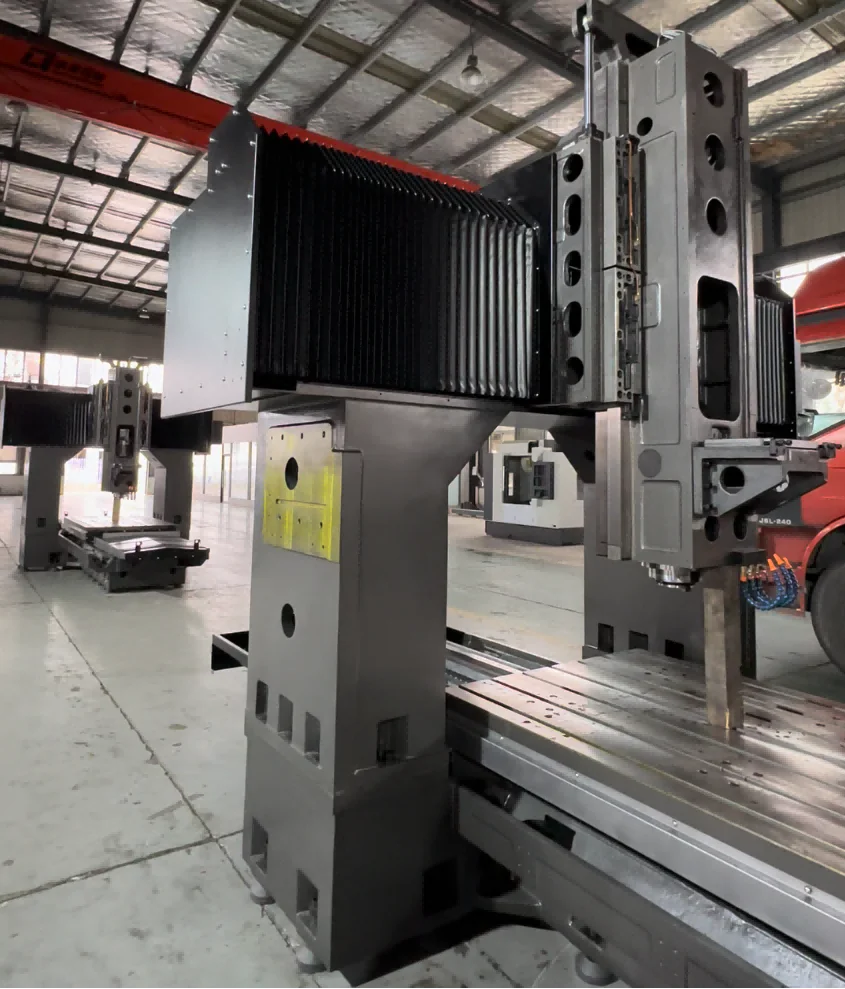
In today’s fast-evolving manufacturing landscape, the demand for high-precision, large-scale machining solutions continues to grow. Gantry machining centers—also known as double-column machining centers—have become essential equipment in industries such as aerospace, automotive, mold making, energy, and heavy equipment manufacturing. The image above showcases a heavy-duty gantry machining center structure inside a modern factory, highlighting its robust casting, wide working table, and vertical spindle configuration.
Choosing the right gantry machining center is not just about purchasing equipment—it is about making a strategic investment that directly impacts production efficiency, machining accuracy, and long-term operational costs. This article explores the key factors to consider when selecting the ideal gantry CNC machine.
1. Understand Your Machining Requirements
Before selecting a gantry machining center, manufacturers must clearly define their production needs. This includes:
Workpiece size and weight: Large molds, structural parts, or heavy components require machines with extended X-axis travel and high load-bearing tables.
Material type: Steel, aluminum, titanium, or composites demand different spindle power and cutting capabilities.
Machining complexity: 3-axis, 4-axis, or 5-axis configurations should be chosen depending on part geometry.
A mismatch between machine capability and application requirements can lead to inefficiencies or unnecessary investment.
2. Machine Structure and Rigidity
The most critical feature of any gantry machining center is its structural rigidity. As shown in the image, the machine adopts a high-rigidity casting structure, including:
Double-column frame design
Heavy-duty crossbeam
Reinforced base and saddle
These components ensure minimal vibration during heavy cutting, which is essential for maintaining precision and surface finish.
High-quality cast iron with optimized ribbed structures improves thermal stability and reduces deformation over time. When evaluating machines, always consider the weight of the casting and the design of internal reinforcements.
3. Guideway Type: Box Guideway vs Linear Guideway
Another crucial factor is the type of guideway system:
Box Guideways (Hard Rail)
Better for heavy cutting
Higher load capacity
Superior damping performance
Linear Guideways
Faster movement speeds
Higher positioning accuracy
Suitable for high-speed machining
For industries like mold manufacturing or heavy-duty machining, box guideways are often preferred. However, for high-speed applications such as aluminum parts, linear guideways may be more suitable.
4. Spindle Performance and Power
The spindle is the core of any CNC machining center. Key considerations include:
Spindle speed (RPM)
Torque output
Motor power (kW)
Cooling system (oil cooling or air cooling)
Heavy-duty gantry machines typically require high torque at low speeds for cutting hard materials. For precision and high-speed applications, a high-speed spindle with excellent dynamic balance is essential.
Additionally, consider whether the machine supports different spindle types such as gear-driven spindles or direct-drive spindles.
5. Working Envelope and Travel Range
The effective working area determines the size of parts that can be processed. Important parameters include:
X-axis travel (table length)
Y-axis travel (gantry width)
Z-axis travel (vertical clearance)
As seen in the image, gantry machines provide a wide working table and high column clearance, making them ideal for large components. Always ensure the machine offers sufficient clearance for tooling and fixtures.
6. CNC Control System
The CNC controller plays a vital role in machine performance and usability. Popular control systems include:
User-friendly interface
High-speed processing capability
Multi-axis control support
Compatibility with CAD/CAM software
Advanced CNC systems improve machining efficiency, reduce programming time, and enhance precision.
7. Automatic Tool Changer (ATC) and Automation
Modern manufacturing requires high efficiency and reduced manual intervention. Therefore, consider:
Tool magazine capacity
Tool change speed
Automation integration (robot loading, pallet changer)
An efficient ATC system can significantly reduce downtime and improve productivity, especially in batch production.
8. Accuracy and Stability
Precision is a defining factor for any machining center. Key indicators include:
Positioning accuracy
Repeatability
Thermal stability
Machines with high-quality components such as precision ball screws, linear scales, and temperature compensation systems offer superior performance.
9. After-Sales Service and Support
A gantry machining center is a long-term investment. Reliable after-sales service ensures:
Timely maintenance
Spare parts availability
Technical support and training
Choosing a manufacturer with a strong global service network can reduce downtime and operational risks.
10. Cost vs Value
While price is always a consideration, it should not be the sole deciding factor. A lower-cost machine may lead to:
Higher maintenance costs
Reduced accuracy over time
Lower productivity
Instead, focus on the total cost of ownership (TCO), including energy consumption, maintenance, and lifespan.
Conclusion
Selecting the right gantry machining center requires a comprehensive evaluation of technical specifications, structural design, and application needs. As illustrated in the image, a well-built machine with high rigidity, stable structure, and advanced features can significantly enhance manufacturing capabilities.
In an increasingly competitive global market, investing in the right CNC gantry machine is not just about improving production—it is about securing long-term success, efficiency, and precision.